
2027 Business Benchmarks report: Minnesota’s economic runway
Quick menu
BACK TO TOP
A note from the CEO
Minnesota’s economic standing is at a turning point
Minnesota built its prosperity on the strength of its private-sector. Generations of entrepreneurs, employers and employees turned new ideas into industries that earned the state a reputation for economic strength and a high quality of life. That legacy remains real, but past performance cannot secure Minnesota’s future.
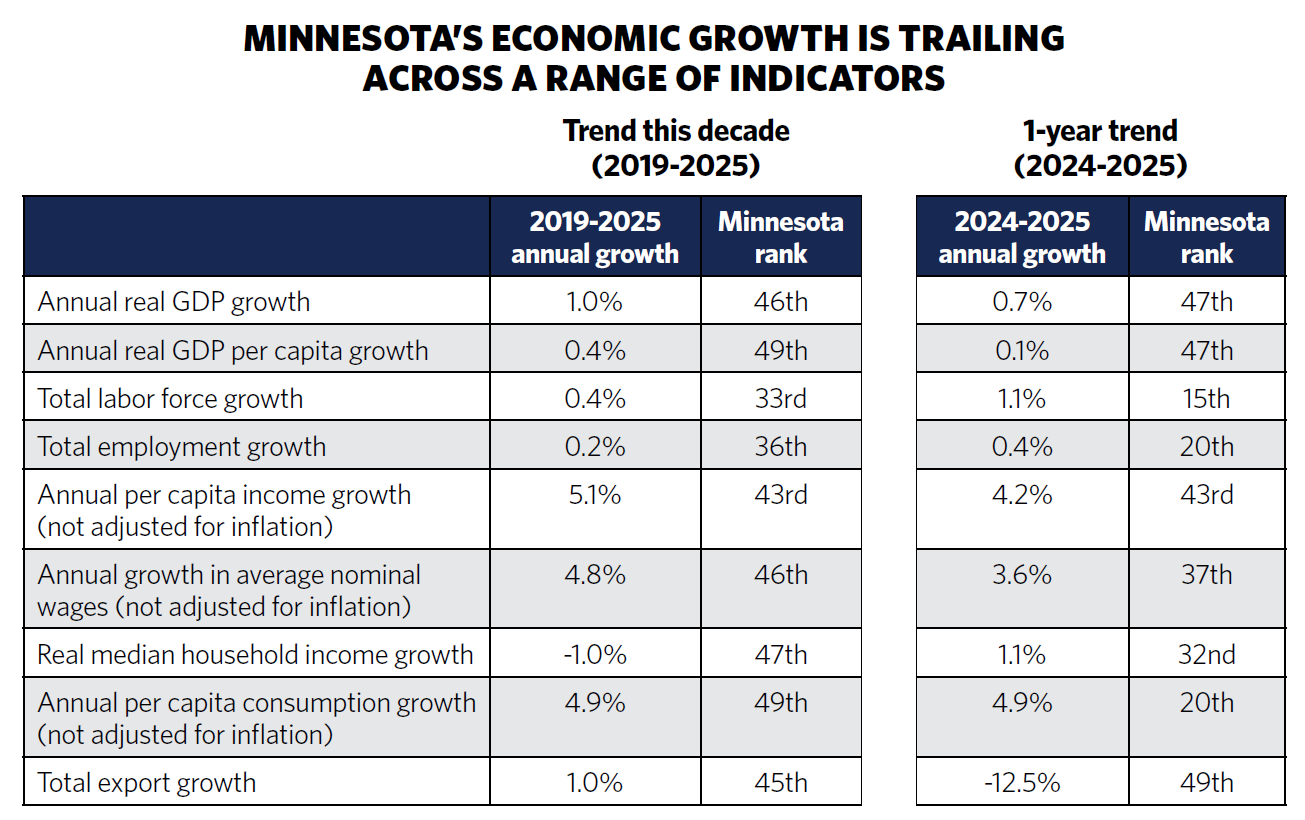
The latest evidence tells us that Minnesota is falling behind the rest of the country. Last year’s Business Benchmarks report found the state in the bottom third on core growth indicators, and the newest data deepen that concern. The latest data show the economy growing even more slowly leaving Minnesota 49th among 50 states in GDP per capita growth this decade. Since 2019, the state ranks 43rd in per capita income growth, 46th in average wage growth, 47th in median household income growth and 45th in export growth. Slower growth has real consequences. It determines whether employers can compete, whether workers see their paychecks rise and whether communities have the resources to thrive. Growth is a means rather than an end, yet every lasting gain in wages, business strength and community well-being depends on it.
The Minnesota Chamber has made growth the focus of a statewide campaign: Minnesota’s economic imperative for growth. The campaign asks employers and policymakers to identify what stands in the way and act together to restore the state’s economic momentum. Three measures chart the course.
GDP per capita: Accelerating growth and prosperity in Minnesota
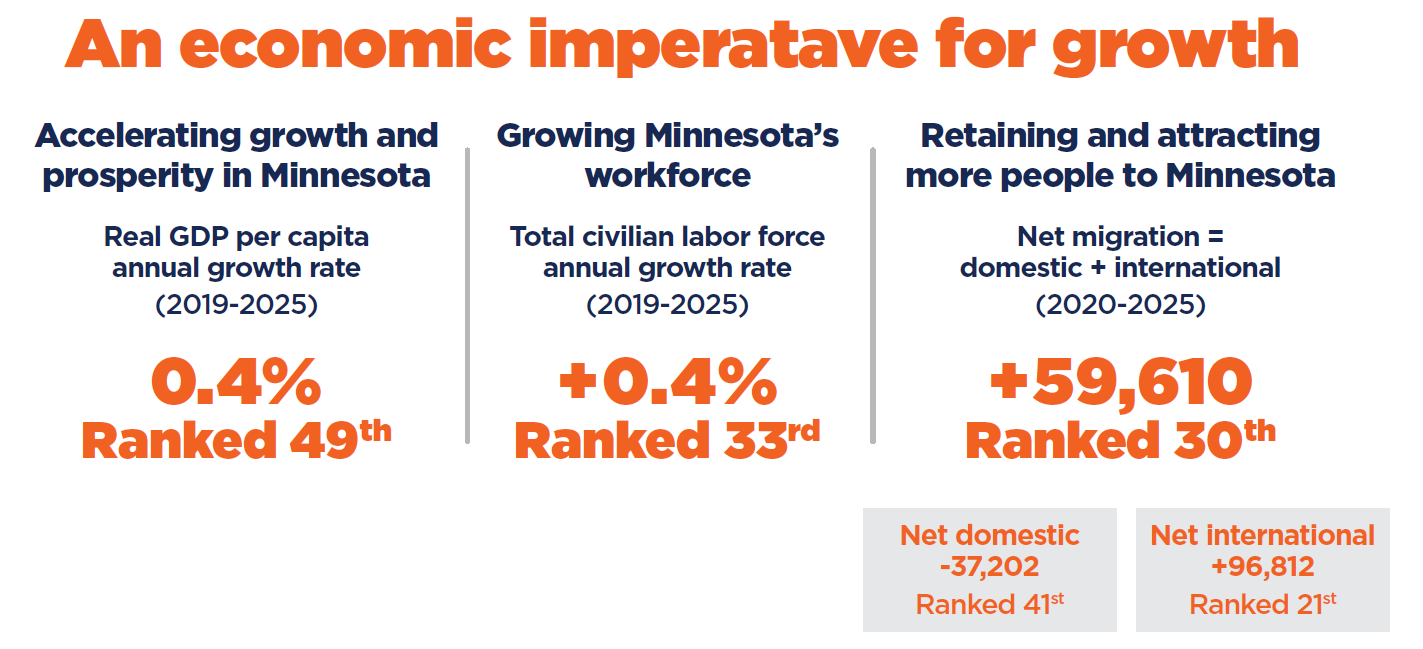
GDP per capita measures total growth in the economy on a per person basis. Growth in per capita GDP is a key driver of growth in average incomes and overall success. It is the clearest gauge of prosperity and a driver of wages, spending and investment. Annual growth averaged just 0.4% from 2019 to 2025 and has nearly stalled since 2023, reaching only 0.1% from 2024 to 2025. At this pace, the economy cannot deliver rising opportunity for families, communities and employers.
TREND: Minnesota’s economic growth has stalled
since 2023, with the state ranking 49th among 50
states in GDP per capita growth this decade.
Labor force growth: Growing Minnesota’s workforce
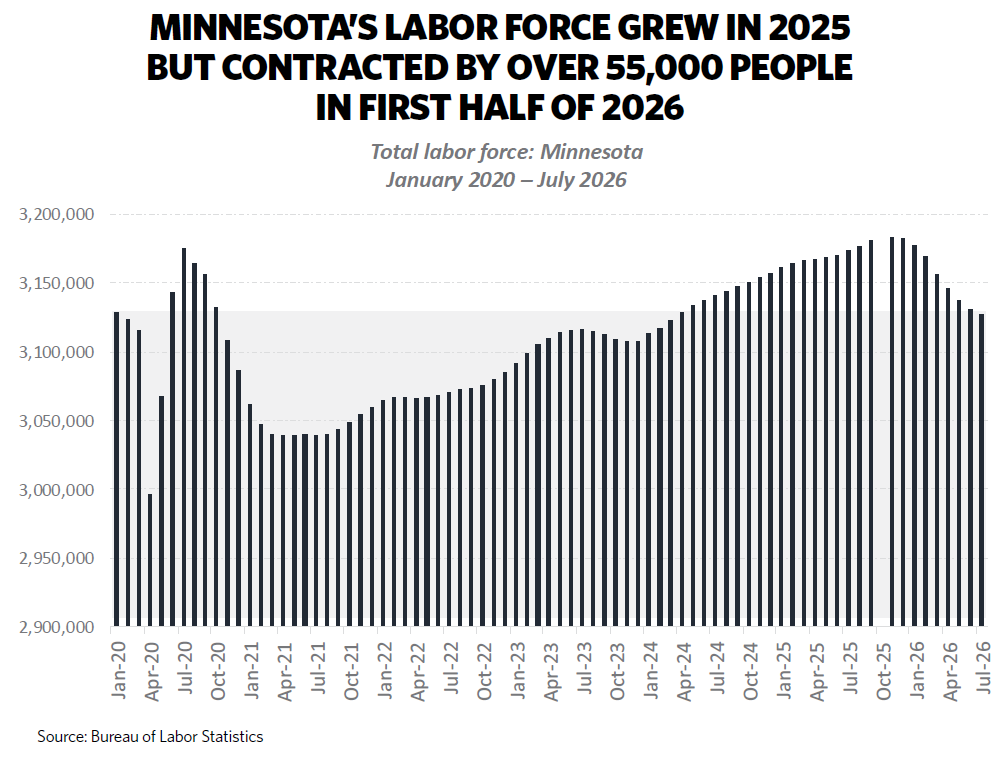
Labor force growth shows how the size of Minnesota’s workforce is changing over time. Minnesota has long counted its workforce among its greatest assets, but that workforce has stopped expanding. A growing workforce is critical to enable continued business growth and supply of vital goods and services in the local economy. The state gained nearly 34,000 workers in 2025, then lost more than 55,000 between January and July 2026, falling below the size of its labor force at the start of the decade. Because the population is aging and natural growth is slowing, the labor force is projected to grow just 0.2% a year over the coming decades.
TREND: As of the middle of 2026, Minnesota’s
total labor force fell below January 2020 levels,
leaving the state with a smaller workforce than it
had at the beginning of the decade.
Net domestic migration: Competing for talent and population
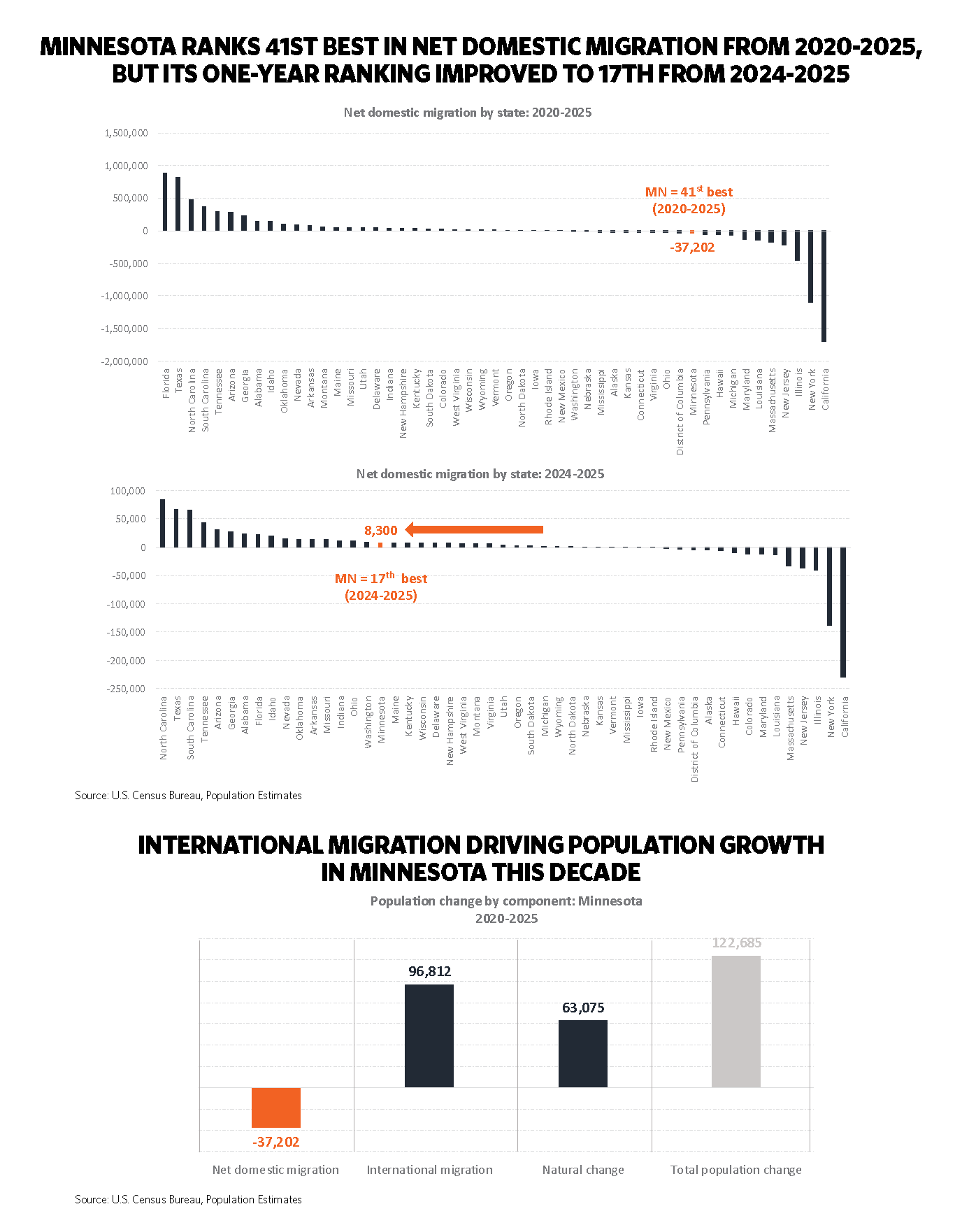
Net migration measures how many people are moving to Minnesota compared to the number of residents leaving the state. This impacts the size of the population and workforce, and it reflects how people choose where to live, work and do business. In the first half of the decade, Minnesota lost a net 37,202 residents to other states, ranking 41st. The most recent year brought a shift: domestic migration turned positive while international migration dropped sharply. Net migration has added just over 59,000 residents since 2020, which ranks 30th and falls well short of what population and workforce growth require.
TREND: Flat labor force growth has been
exacerbated by low net migration into Minnesota.
Many factors shape the quality and vitality of an economy, but steady growth underpins them all. Without it, no state can sustain strong outcomes for households, communities and businesses. Communities thrive when job opportunities expand and people advance in their careers, when new businesses form and existing ones grow, when cities and regions attract new residents, and when enough workers are available to provide the goods and services depended on by local consumers.
A blueprint for growth
Changing course will take deliberate effort. In 2026, the Minnesota Chamber Foundation released the Blueprint for Economic Growth, which organizes that effort around three imperatives: driving investment and innovation, upskilling Minnesota’s workforce and leading the Midwest in talent attraction and retention. This year, the Chamber will concentrate on three priorities:
- Make it easier to expand and locate in Minnesota. Quicker permitting, simpler incentive programs, more shovel-ready sites and workforce training matched to project needs would give businesses the confidence to move quickly and bring new jobs and investment to communities.
- Strengthen cost competitiveness for the long term. A comprehensive review of the tax system, combined with policies that broaden the economic base, would position Minnesota to win investment while keeping the state budget stable.
- Deepen partnerships between business and education. Stronger ties among employers, schools and training providers would align instruction with workplace demands, including AI and advanced technology. They would also expand internships, apprenticeships and other pathways into good careers.
The path forward
Minnesota is facing a challenging economic runway. Let’s be sure to take measures now for a successful future for our state. The state’s amazing leading companies, skilled workforce and culture of innovation provide a strong foundation, but that foundation alone will not overcome the obstacles ahead.
Join us in working to double Minnesota’s economic growth. The Minnesota Chamber will lead this work by bringing employers together, equipping policymakers and the public with sound data, and advancing practical solutions that return Minnesota to a path of growth.
Growth is Minnesota’s economic imperative, and the moment to pursue it is now.
BACK TO TOP
Accelerating growth and prosperity in Minnesota
Growth in Gross Domestic Product (GDP) per capita
What is it and why does it matter?
Gross Domestic Product (GDP) per capita measures the total value of goods and services an economy produces per person. This is a commonly used measurement of economic output and prosperity, and allows comparisons across states and over time.
GDP is typically derived by calculating the sum of consumption, business investment, goods and services sold to government and net exports (C + I + G + (X – M)). Alternative calculation methods, such as the income approach and production approach, incorporate data on personal and household income, sectoral activity and so forth, providing additional inputs to understand the nature of changes in economic activity. Taken together, GDP statistics help answer questions about whether personal income and consumption is increasing or decreasing, whether businesses are investing in new facilities, equipment and technologies, whether the state or country is exporting more than it is importing, and so forth.
Official GDP estimates for locations in the United States are produced quarterly by the Bureau of Economic Analysis (BEA). Population estimates are produced annually by the U.S. Census Bureau.
How is Minnesota performing?
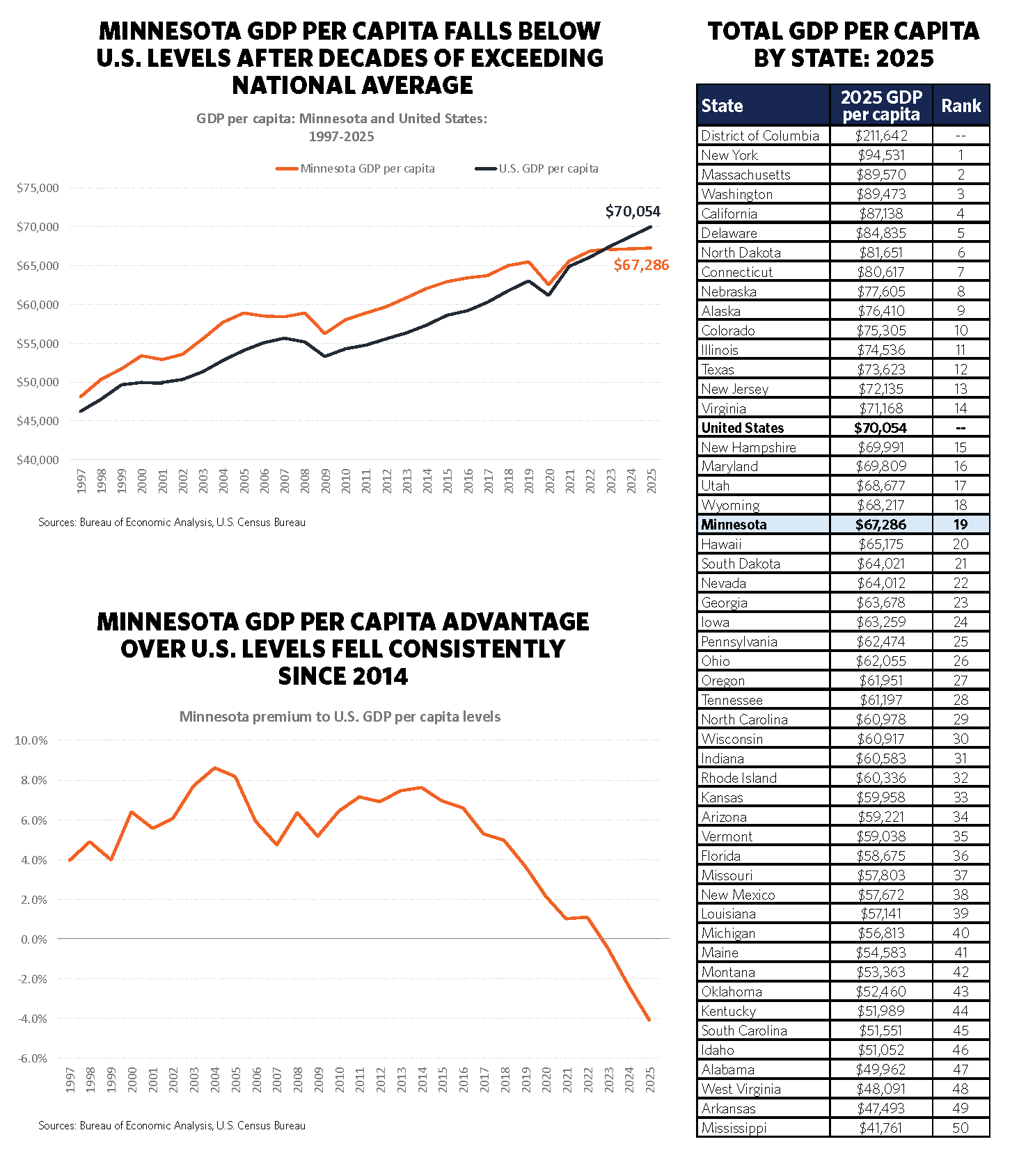
For decades, Minnesota produced more economic value per person than the national average, which supported higher incomes and prosperity across the state. At its peak in 2005, Minnesota had the 9th highest GDP per capita among all states. However, slowing growth has led Minnesota’s advantage to erode over time. By 2023, Minnesota’s total GDP per capita fell below the U.S. average for the first time since at least 1997. This means that Minnesota’s total output per person fell to 19th highest nationally – being surpassed by 10 other states since 2005.
From 2019-2025, per capita GDP grew 0.4% annually in Minnesota versus 1.8% nationally. Minnesota ranked 49th among states in GDP per capita growth from 2019-2025 and ranked 47th over the year from 2024-2025.
Minnesota’s low economic growth rates reflect broader trends within the upper Midwest. Each of Minnesota’s neighboring states ranked in the bottom twenty states nationally in per capita GDP growth since 2019, with South Dakota ranking 33rd, Wisconsin 38th, Iowa 40th and North Dakota 41st. Similar trends are evident across various measures of economic growth, suggesting that Minnesota may be facing shared challenges related to demographics, industry structure, consumer activity or other factors impacting states across the region.
What slower growth means for Minnesota
Sustained growth in GDP per capita is an essential indicator of increasing prosperity. Part of what GDP measures is the level and change in personal income and consumption activity within a given area. Rising GDP is thus a reflection of rising incomes, rather than a cause of it. States with high GDP per capita have higher per capita income levels, while low GDP per capita states have lower incomes.
As Minnesota’s economic growth has lagged the U.S. average and other states, so too has its per capita income and wage growth. As of 2025, Minnesota still had the 16th highest per capita income levels among states. However, Minnesota ranked 43rd in income growth since 2019 and ranked 42nd in growth since 2015. Over the past decade, Minnesota’s per capita incomes have converged closer to the U.S. average as U.S. incomes have grown faster than incomes in the state.
Slow economic growth over the medium to long term has other implications beyond personal incomes and consumption. It may reflect underinvestment in private capital, declining export competitiveness or poor performance in certain sectors, all of which contribute to the overall size and quality of the state economy.
BACK TO TOP
Growing Minnesota’s workforce
Labor force growth
What is it and why does it matter?
Labor force growth measures changes in the total number of people in Minnesota’s workforce (i.e., individuals 16 years and older who are currently employed or actively seeking employment). It shows how Minnesota’s workforce is growing over time, how its growth compares to other states and the U.S. labor force.
A growing workforce indicates growth in the economy’s capacity to produce goods and services. It also enables the availability of workers needed for businesses to grow and expand in the state. Minnesota labor force statistics are produced by the Bureau of Labor Statistics, in partnership with state agencies, such as the Department of Employment and Economic Development.
How is Minnesota performing?
The size of Minnesota’s workforce remained relatively flat over the first six years of the decade. Minnesota added 66,436 people to the labor force between 2019-2025, growing just 0.4% annually. However, this modest change masks larger ups and downs taking place across the period. Minnesota lost over 85,000 people from the labor force during the first year of the COVID-19 pandemic before recovering to pre-pandemic levels by the middle of 2024.
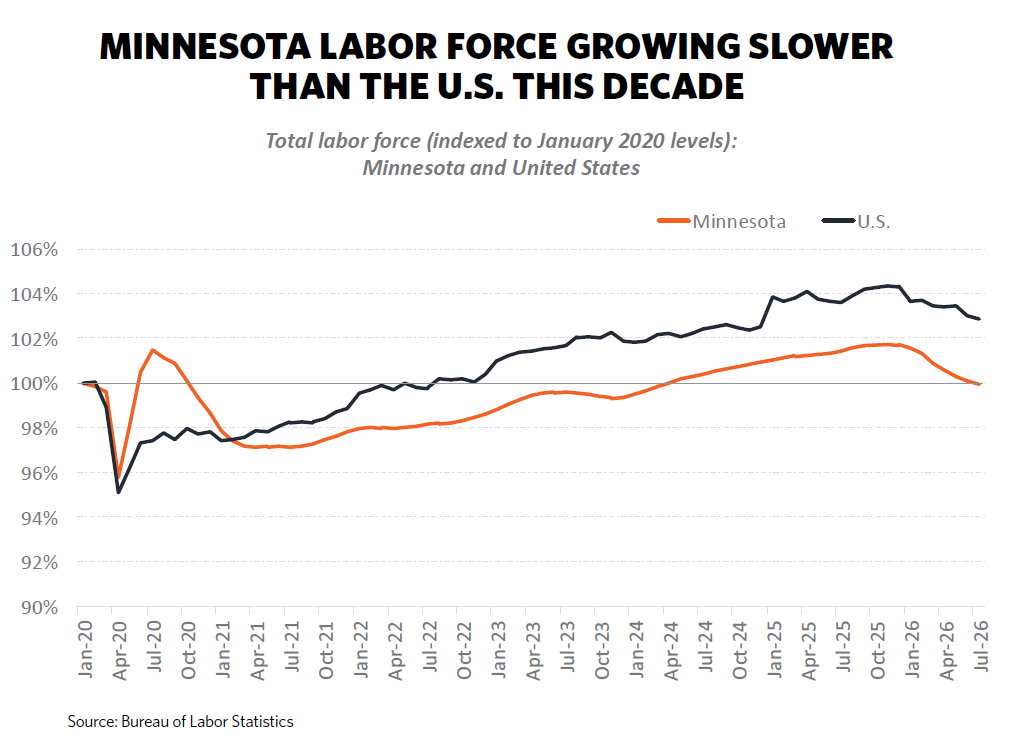
In 2025, Minnesota’s labor force expanded at a strong rate of 1.1%, adding nearly 34,000 new individuals to the workforce. The first half of 2026 brought more headwinds, however, as the state’s labor force contracted by over 55,000 workers from January to July 2026. Minnesota’s labor force declines followed the national trendline but fell at a steeper rate at the state level.
By July 2026, the total number of people in Minnesota’s workforce once again had fallen below January 2020 levels, even as the state’s unemployment rate rose steadily, suggesting weakening labor market conditions.
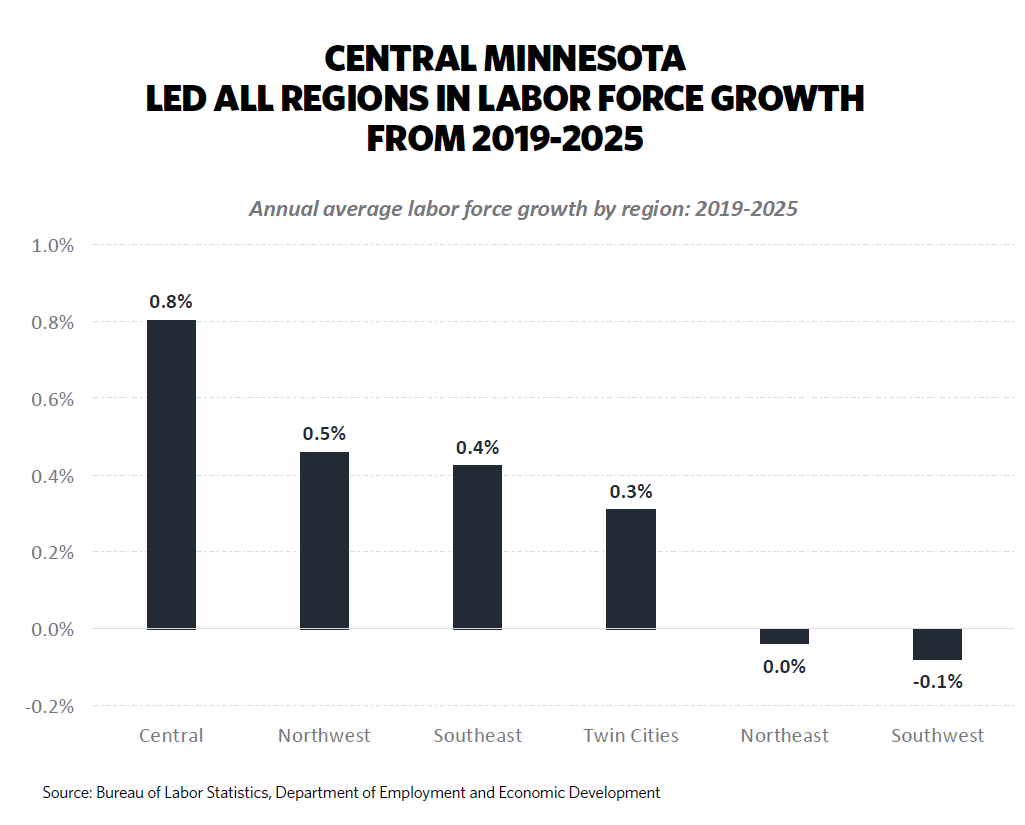
Labor force outcomes varied across Minnesota’s regional economies this decade. Central Minnesota saw the largest percent gains – growing by 0.8% annually – while Southwest Minnesota experienced a net decline in the size of its labor force, declining by – 0.1% annually. Minnesota’s largest economic region – the seven-county Twin Cities metro – grew by 0.3% annually since 2019.
Each regional economy in Minnesota experienced sharp declines in total workforce levels in the first half of 2026, following statewide trends.
What slower growth means for Minnesota
Steady growth in the size of the workforce is a foundational component of overall economic growth. Without a growing labor force, the state must rely entirely on productivity gains to support sustained economic growth.
A slowing workforce presents short-term challenges for businesses seeking to grow and expand in the state. Minnesota businesses continue to report hiring difficulties, even as unemployment has increased moderately over the past year.
Slow labor force growth may hinder business investments, as companies tend to grow and create new jobs in regions with growing populations and workforces.
Further, a lack of growth in the workforce could lead to a reduction in access to local goods and services for local consumers, such as health care services, construction, emergency response services, utilities and so forth, as employers face workforce shortages in a variety of roles.
BACK TO TOP
Competing for talent and population
Migration – Retaining and attracting population
What is it and why does it matter?
Net migration measures the number of people moving to the state minus the number of people leaving the state. This is broken down into two components: domestic migration and international migration. Migration impacts economic growth in multiple ways. First, net migration is making up a larger share of overall population and workforce gains, as natural population growth (births – deaths) slows over time. The Minnesota State Demographer projects that Minnesota will experience more deaths than births by 2065, leaving the state entirely dependent on migration to sustain population growth. Second, positive migration flows to the state could spur additional investments from businesses, as firms often look to expand and create jobs in regions and states with growing populations.
Domestic and international migration data come primarily from the U.S. Census Bureau through its annual Population Estimates and American Community Survey products.
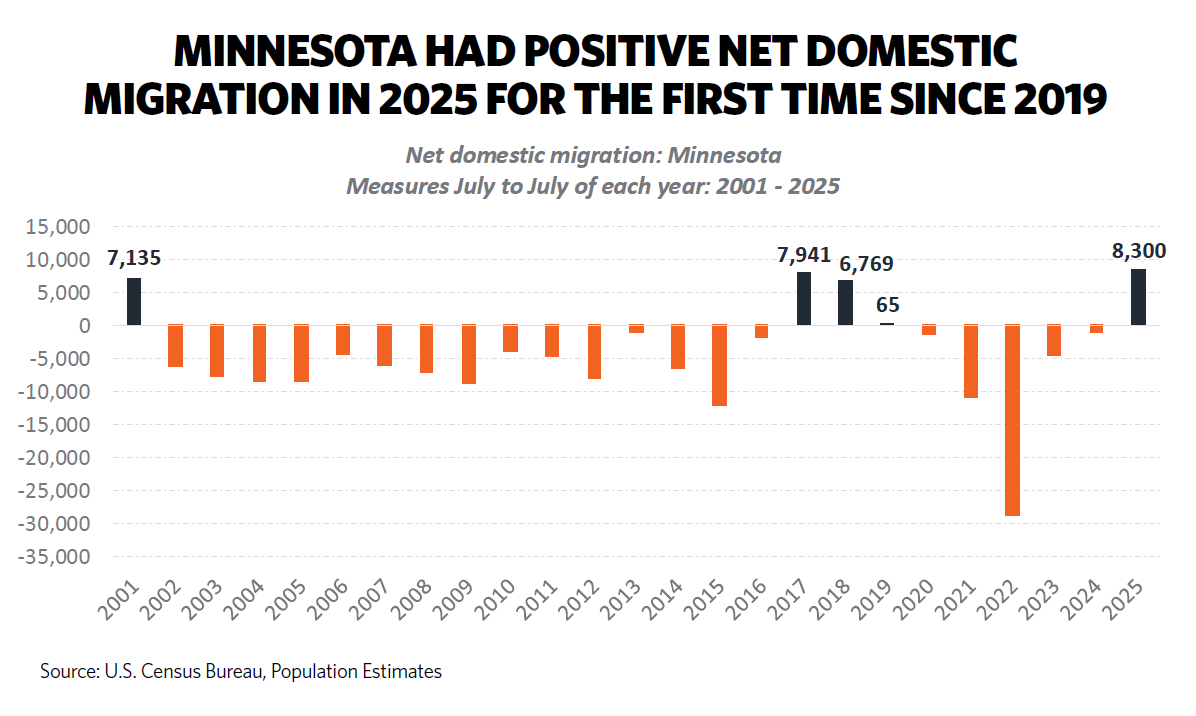
How is Minnesota performing? Over the past quarter century, Minnesota experienced net gains in international migration but had consistent net domestic migration losses.
This trend continued in the first half of the 2020’s, as Minnesota lost a net of -37,202 people to other states, but gained a net of +96,812 new residents from other countries. International migration was the leading component of population change since 2020.
Minnesota ranked in the bottom ten states in net domestic migration this decade, ranking 41st best since 2020. Outcomes improved in 2025, however, as 8,300 more people moved to Minnesota than left the state. This was the first time Minnesota experienced net domestic migration gains since 2019 and only the fifth time since 2001.
What slower growth means for Minnesota
Trends from the past year show mixed results and implications going forward. On the plus side, the state’s recently improved domestic migration outcomes could signal the potential for further population and workforce growth. However, international migration flows reduced substantially from the middle of 2024 to mid-2025.
Minnesota’s ability to grow the population would be enhanced by combining both positive domestic and international migration. This will be increasingly important to offset further expected declines in natural population growth in coming years.
BACK TO TOP

Questions about the 2026 Business Benchmarks report?
We'd love to hear from you! If you have questions on this year's Business Benchmarks or would like to get involved on the topics listed above, please contact us or reach out to one of our expert staff.